US Army Air Corps Stratosphere Flight Balloon Black White Real Photo Postcard
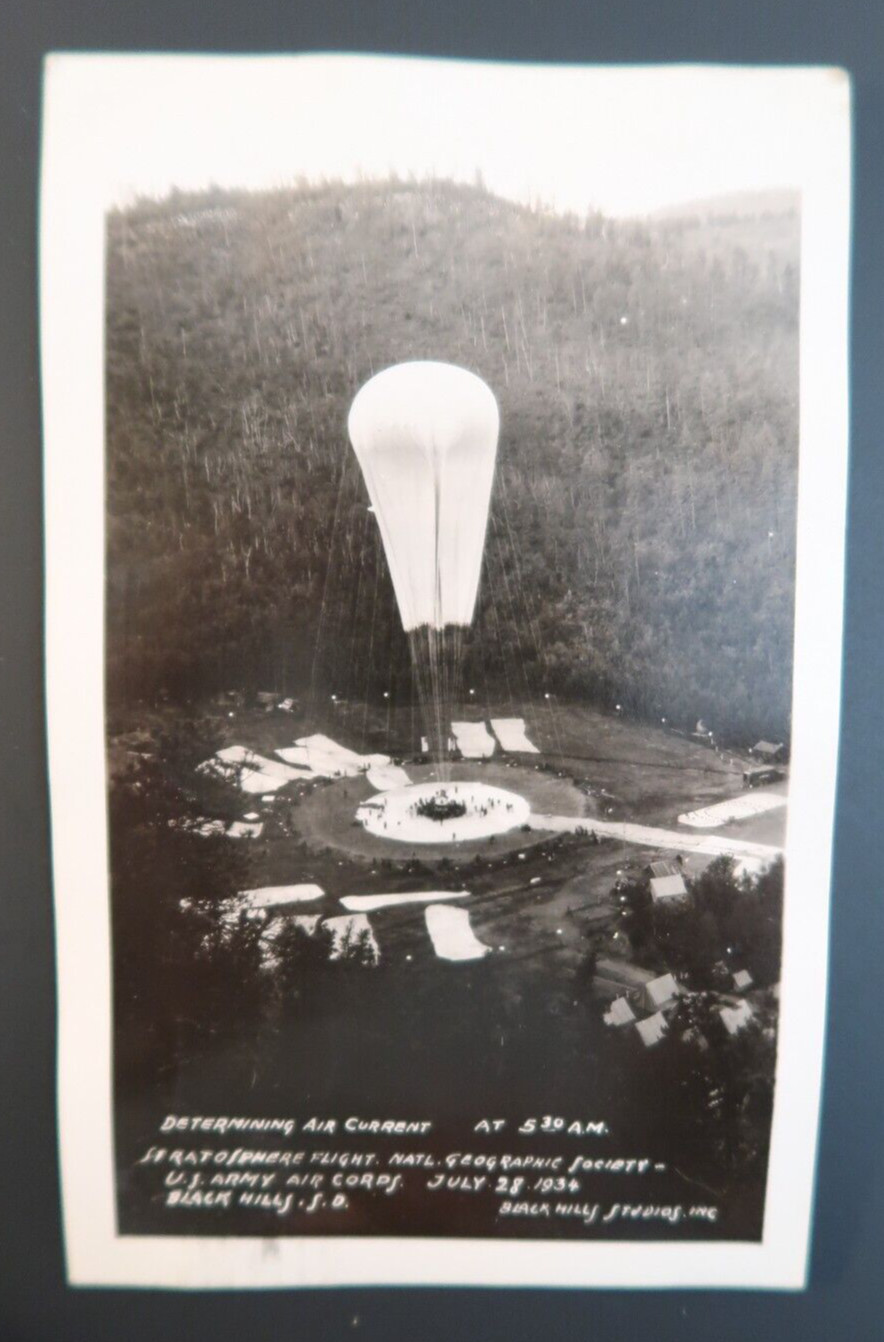
The image captures the preparations for a pioneering stratosphere flight attempted on July 28, 1934, in the Black Hills, South Dakota. This expedition, known as the "Century of Progress" flight or Explorer I, was a collaborative effort between the National Geographic Society and the U.S. Army Air Corps, aiming to send a manned gondola to unprecedented altitudes for scientific research. Its primary objective was to collect data on cosmic rays, atmospheric composition, and meteorological conditions in the upper reaches of Earth's atmosphere.
These early stratosphere flights were crucial endeavors in the history of aerial exploration, pushing the boundaries of human endurance and scientific instrumentation. While the July 1934 flight ended with a dramatic rupture of the balloon during inflation, forcing an abort, it laid vital groundwork for subsequent, more successful missions like Explorer II. Such expeditions were pivotal for advancing knowledge about the upper atmosphere and developing technologies that would eventually contribute to the space age.
These early stratosphere flights were crucial endeavors in the history of aerial exploration, pushing the boundaries of human endurance and scientific instrumentation. While the July 1934 flight ended with a dramatic rupture of the balloon during inflation, forcing an abort, it laid vital groundwork for subsequent, more successful missions like Explorer II. Such expeditions were pivotal for advancing knowledge about the upper atmosphere and developing technologies that would eventually contribute to the space age.